If your car has stalled on the shoulder of I-40 near Crabtree, or you’re sitting on the I-440 Beltline watching brake lights stack up behind you, the tow truck that shows up matters more than most drivers realize. A standard hook-and-chain tow can work fine for a lot of situations – but for a growing share of vehicles on Raleigh’s roads, it’s the wrong tool entirely, and using it can turn a bad morning into an expensive one.
That’s where flatbed towing in Raleigh comes in. Instead of dragging two wheels along the pavement, a flatbed tow truck lifts your entire vehicle off the ground and carries it, fully supported, on a hydraulic deck. It’s the standard for AWD cars, EVs, lowered vehicles, motorcycles, and anything that’s been in a collision – and increasingly, it’s just the smarter default for any tow across Wake County’s highway network.
This guide covers what flatbed towing actually involves, when it’s non-negotiable, what it costs, and what to do if you’re stuck on I-40, US-1, or the Beltline right now.
What Is Flatbed Towing, Exactly?
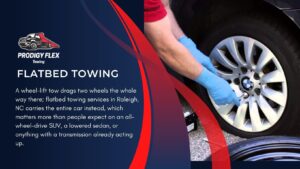
A flatbed (also called a “rollback”) is a tow truck with a flat hydraulic bed that tilts down to ground level, lets your vehicle drive or winch on, then tilts back and locks flat for transport. Every wheel leaves the road. Nothing drags, spins, or bears weight it wasn’t designed for during the trip.
Compare that to hook-and-chain or wheel-lift towing, where two wheels stay on the pavement and roll the entire distance. For a simple rear-wheel-drive sedan going a few miles, that’s usually fine. For a lot of modern vehicles, it isn’t:
- All-wheel-drive and four-wheel-drive vehicles can suffer transmission and transfer-case damage when only two wheels turn during a tow – the drivetrain isn’t built to have one axle moving while the other sits still.
- Electric vehicles carry battery packs low in the chassis, and towing with wheels on the ground risks regenerative braking engaging unpredictably or drawing down the pack in a way it wasn’t designed for.
- Lowered or modified cars frequently don’t have the ground clearance for a wheel-lift rig without scraping the front bumper or splitter.
- Motorcycles and collision vehicles need full support – there’s no safe way to drag a bike or a car with front-end damage.
If any of those apply, flatbed isn’t the premium option. It’s the only correct one.
Why Raleigh’s Roads Make Flatbed Towing the Right Default
Raleigh’s highway layout creates specific recovery challenges that a lot of generic towing content skips over entirely.
- I-40 and I-440 (the Beltline) carry heavy commuter volume through Crabtree, Cameron Village, and the Wade Avenue interchange. Shoulders are narrow in several stretches, and traffic doesn’t slow down for a disabled vehicle the way it should. A flatbed crew that knows these merge points can position the truck to shield the vehicle and load quickly, cutting down the time a driver spends exposed on an active shoulder.
- US-1 / Capital Boulevard has a mix of surface-street and limited-access sections, which means the tow crew needs to know exactly where the nearest safe pull-off is rather than guessing in real time.
- US-70 and Wake Forest Road see frequent congestion near Crabtree Valley and North Hills, where a slow hook-and-chain load can back up traffic for blocks.
- Cary, Apex, Garner, and Wake Forest connections mean a lot of “Raleigh” towns are actually cross-county runs on 540 or 64, where higher sustained speeds make flatbed transport safer for long-distance hauls regardless of vehicle type.
Local road knowledge isn’t a marketing line – it’s the difference between a five-minute load and a fifteen-minute one spent stopped on an active highway shoulder.
What to Do If You’re Stranded on a Raleigh Highway Right Now
If you’re on the shoulder of I-40, I-440, or US-1 waiting for a tow, a few things genuinely reduce risk while you wait:
- Turn your wheels away from traffic if you’re on the left shoulder, so a rear impact pushes the car away from the road, not into it.
- Stay inside the vehicle with your seatbelt on if you’re on a high-speed shoulder with no barrier – exiting onto an active highway is often more dangerous than staying put.
- Turn on hazard lights immediately, even before you’ve fully stopped moving.
- If you must exit (smoke, fire risk, or a safe grassy shoulder well off the travel lane), get behind a guardrail or well beyond the rumble strip, not just outside the car door.
- Share your exact location with the dispatcher – mile marker, nearest exit, or a cross street – since GPS pins can be off by a quarter mile on limited-access highways.
What Affects the Cost of Flatbed Towing in Raleigh
Pricing for flatbed towing isn’t random, even though a lot of towing pages avoid the topic entirely. The main factors:
A legitimate provider should be able to give you a straightforward estimate range over the phone once they know your location, vehicle type, and destination – not just “we’ll figure it out when we get there.”
Flatbed Towing for Specialty and High-Value Vehicles
A meaningful share of flatbed calls in Raleigh aren’t roadside breakdowns at all – they’re planned transports for vehicles that simply can’t ride on a hook-and-chain rig:
- Classic and collector cars, where suspension components and original drivetrain parts weren’t engineered for modern tow standards.
- Luxury and exotic vehicles, where low ground clearance and sensitive undercarriage sensors make anything but a flat deck risky.
- Dealership and auction transports, moving non-running inventory between lots without adding mileage or wear.
- Motorcycles, which require dedicated wheel chocks and multi-point tie-downs rather than a standard tow hitch.
For all of these, the loading process matters as much as the truck itself – correct tie-down points, soft straps on painted or carbon-fiber surfaces, and a deck angle shallow enough that low-clearance vehicles don’t scrape on the approach.
Rotation Towing, NCDOT, and What “Licensed and Insured” Actually Means
North Carolina highway patrol and NCDOT maintain rotation lists for companies authorized to respond to accident and disabled-vehicle calls on state highways. Being on that rotation isn’t automatic – it requires meeting equipment, insurance, and response-time standards. When a towing company mentions they’re part of the local rotation system, that’s a concrete credential, not a throwaway phrase, and it’s worth asking about directly if you’re comparing providers for a business account or fleet contract.
Beyond rotation status, ask any provider about cargo insurance specifically (not just general liability) – that’s what actually covers your vehicle if something goes wrong during transport.
Choosing a Flatbed Towing Company in Raleigh
A few practical questions cut through the marketing copy fast:
- Is the truck actually a flatbed, or wheel-lift with flatbed in the name? Ask directly – some fleets mix truck types and dispatch whichever is closest.
- What’s the real ETA, not the optimistic one? Rush hour on I-440 changes response time significantly.
- Do they cover your specific vehicle type? Confirm deck length and weight capacity for trucks, vans, or oversized SUVs before they arrive.
- Is pricing explained before the truck leaves the yard? A vague answer here usually means a vague invoice later.
- Are they available 24/7, genuinely? Overnight breakdowns on US-1 or I-40 are common – confirm this isn’t a daytime-only service with an answering machine after 9 PM.
FAQ’s
What’s the difference between flatbed towing and regular towing?
Flatbed towing lifts your entire vehicle off the ground onto a flat deck, so no wheels touch the road. Regular (hook-and-chain or wheel-lift) towing leaves two wheels on the pavement, which can damage AWD drivetrains, EVs, and low-clearance vehicles.
Is flatbed towing more expensive than standard towing?
It can run slightly higher due to loading time and equipment, but for AWD, EV, or damaged vehicles it’s often the only safe option – making it cost-effective by avoiding drivetrain or undercarriage damage a cheaper tow could cause.
How fast can a flatbed tow truck reach me on I-40 or I-440 in Raleigh?
Response times vary with traffic and time of day, but companies familiar with Raleigh’s highway network typically reach Beltline and I-40 locations within 20–40 minutes, faster outside rush hour.
Does flatbed towing work for motorcycles?
Yes – motorcycles require flatbed transport with wheel chocks and multi-point tie-downs, since there’s no safe way to tow a bike with a standard hook-and-chain setup.
Will flatbed towing damage my car?
No, when loaded correctly. A trained crew uses proper tie-down points and soft straps on sensitive surfaces, and the flat deck itself eliminates the wheel-drag risk that causes most towing-related damage.
Can a flatbed truck tow long distances from Raleigh to another city?
Yes. Flatbed is generally the preferred method for long-distance tows since it avoids the wear and heat buildup that comes from wheels rolling for extended highway miles.